
Why Art Classes Are Secretly Building Better Learners
Art class often gets treated as the optional, fun subject squeezed in around 'real' academics. Here's the case for why it deserves a more central place in a child's learning — and how it shows up in exam subjects too.
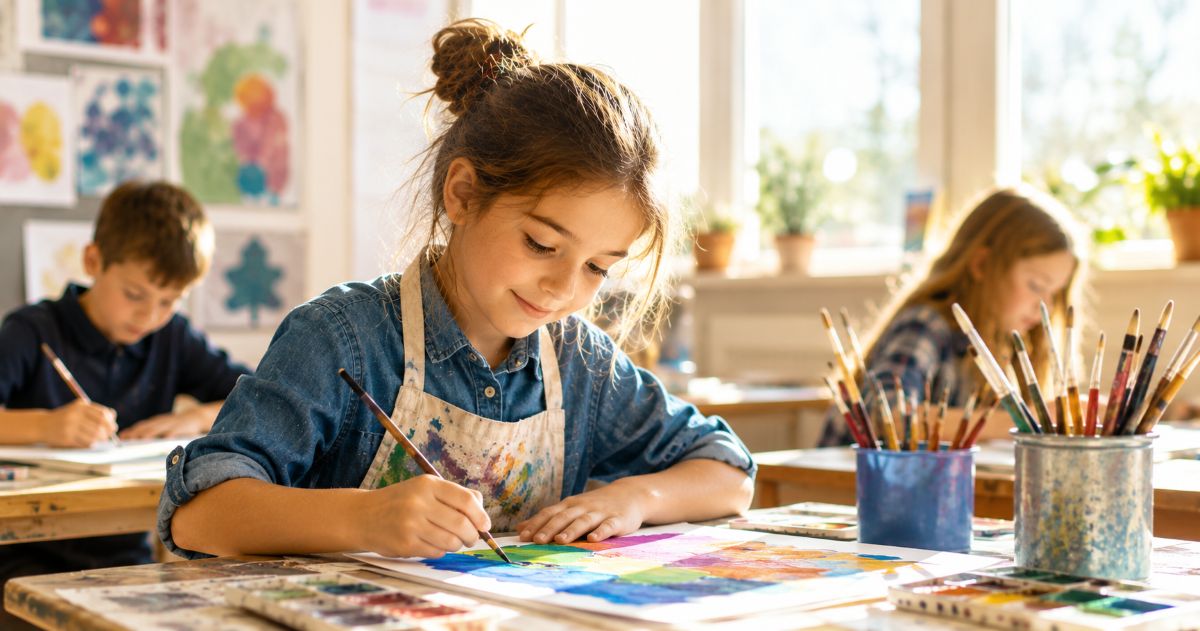
Ask most parents to rank subjects by importance and art tends to land near the bottom — nice to have, but not essential in the way Maths or English are. Having watched a lot of students move between academic tutoring and art class, we'd push back on that ranking. Several skills that art classes build show up directly in how children handle every other subject.
Sustained attention on something imperfect
A maths problem is either right or wrong. A drawing is neither — it's a series of judgement calls, and the first attempt is rarely the one a child is happy with. Sitting with something that isn't finished, isn't perfect, and needs another ten minutes of work builds a specific kind of patience that's genuinely hard to teach directly, but which transfers well to redrafting an essay or reworking a maths method that didn't quite work the first time.
Observation as a skill, not a talent
Good drawing is mostly about looking carefully — noticing proportions, angles, and detail that a quick glance misses. This is a trainable skill, and the practice of really looking at something (a piece of fruit, a face, a building) builds an observational habit that shows up unexpectedly in subjects like science, where careful noticing is exactly what's needed to describe an experiment accurately.
Tolerating mistakes without shutting down
In most academic subjects, a wrong answer feels like a small failure to be corrected and moved past quickly. In art, a "mistake" — a line in the wrong place, a colour that doesn't work — is just information, something to adjust rather than erase and hide. Children who spend regular time in this kind of low-stakes, iterative environment often carry that same resilience into subjects where mistakes usually feel higher-stakes.
A different kind of confidence
Not every child's confidence is built the same way. Some children who find reading or maths genuinely hard find a real sense of competence in art class — a space where their particular way of thinking is an asset rather than an obstacle. That confidence doesn't stay neatly contained to art; a child who feels capable in one area tends to carry a bit more willingness to try in others.
What our art classes actually look like
Our classes run in small groups, giving each student real individual attention rather than a lesson pitched at the middle of a large room. Sessions introduce a range of techniques and materials over time, building genuine skill alongside the confidence to keep going when something doesn't work first try. It's a supportive space — the goal is building creative confidence, not producing gallery-ready pieces on a schedule.
If your child is strong academically but could use a lower-pressure creative outlet, or finds academic subjects harder and needs a space to build confidence a different way, a trial art class is a good way to see whether it's the right fit.
Frequently Asked Questions
Share this post
Comments (0)
No comments yet. Be the first to comment!